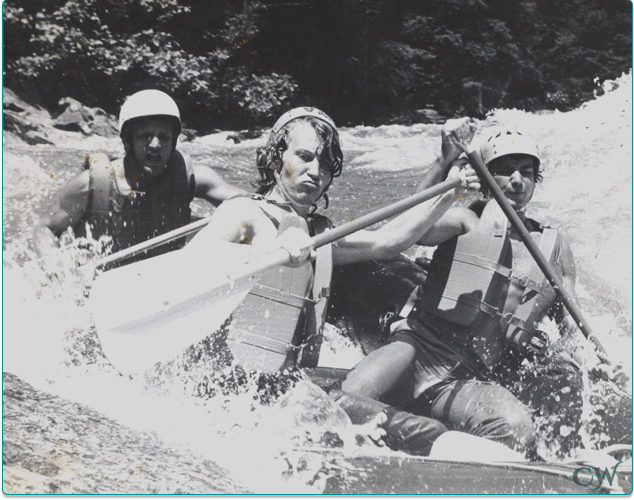
Charlie Walbridge raft guide

Working for NOC in ’74 – A Yankee Paddler Goes South

In the winter of 1973 I found a help-wanted ad for river guides and kayak instructors in the American Whitewater Journal. I sent my application to a place called the Nantahala Outdoor Center in North Carolina and in due course was offered a job. Being a Northern boy, I remember being apprehensive as I drove south the next spring. I’d paddled in the Smokies on two previous occasions with Jack Wright, and the locals seemed friendly enough.  I’d also met lots of likable Southern paddlers at races. But I’d seen the attacks on civil rights protesters on TV as a kid, and more recently watched the movie Deliverance. My Dad, who watched the movie with me, couldn’t understand why I wanted to go DOWN THERE. At a truck stop in East Tennessee I passed up a baseball cap that said, “Keep the South beautiful, put a Yankee on a bus!” I was worried about fitting in.

           I shouldn’t have been concerned. Once I got to the Center, I quickly found myself among friends. But I quickly encountered two distinct types of Southern personalities. One was the strong, calm, thoughtful type exemplified by my boss, Payson Kennedy. In another era he might have been a thoughtful confederate officer. The other was the loud, aggressive, redneck kind personified by my coworker, Donnie Dunton. He was the guy you wanted with you in the trenches!

Payson Kennedy, a former university librarian, had been paddling Southern rivers for decades. A tall man with an athletic build, he was formidable open canoeist. He was also a savvy whitewater guide, an innovative instructor, and a fierce competitor. He’d been a consultant and stunt double in the movie Deliverance. The next year he took the money he’d earned and purchased, with several other investors, a riverside motel (The Tote N’ Tarry) on the Nantahala River. During the next two summers he ran an outfitting business on weekends, going full time when the university closed for the summer. Mostly he employed his family and friends. The previous year Jimmy Holcombe became his first “real” employee.

In 1973 he quit his job and moved to the mountains with his family. The NOC was gearing up for growth, and this meant hiring a staff of about 40 people for the ’74 season. His guides included a handful of top-ranked slalom racers, an assortment of colorful river characters, and the usual college summer work crowd. We all had a lot to learn, and I suspect that some of us would not be hired today.

Donnie Dunton was a short, stocky little dude who stood about 5’4 tall and weighed nearly 260 pounds. He had a bushy brown beard, a huge folding belt knife, and a cowboy hat with a turkey feather in it. He was a friend of Joe Cole, NOC’s river photographer, and when Joe came top the Center he brought Donnie along. Although I never found out exactly where he came from he spoke with the sharp twang of the Southern Appalachians. He was loud, outspoken, quick-tempered, and profane. But because he was competent, unpretentious, and hard-working, the folks at the Center overlooked his rough side and found that behind his bluster was a good-hearted person who you could depend on in tight situations. Our guests either loved him or hated him. Although he was the NOC’s most-requested guide that summer, there were others who asked for “anybody but Donnie”.

I worked regularly with Donnie over on Section IV of the Chattooga. Back then we drove down under the Route 76 Bridge on a dirt road, blew up our rafts with hand-pumps, and waited for the guests. Guides would sit in their boats and wait for the guests to pick the one they wanted to ride with. Conservative customers who wanted a smooth, safe ride chose big, clean-shaven people . . . . like me! Rowdies who wanted big excitement chose guides who looked like Donnie. Unfortunately, the leftover wimps and weenies who wanted someone to mother them down the river chose female guides and the women always got the prize-winning bad crews. For example, I never knew that you could get a four-man raft through the narrow chute at Center Crack until the day that Mikki Piras’ guests stopped paddling and her boat got pushed through . . .on edge! Nowadays nobody allows the guests chose their guides on site anymore!

Occasionally the personalities of crews and guides clashed. One time my trip was approaching Seven-Foot Falls when we noticed that the trip ahead of us had pulled over below the drop. When we got into the eddy, their tripleader asked if I would switch places with Donnie. I did, and finished the run with a nice group from a North Georgia church. They wouldn’t tell me what the problem was, but I later learned from my buddies that Donnie, at the lip of the drop, had screamed at them: “Paddle, you klutzy mother@#%@’s, PADDLE! The group pulled over and refused to continue until they were given another guide.

Guiding Section IV is serious business, so I appreciated Donnie’s frustration. My approach to getting the attention of a spaced-out crew was a bit sneakier. If my guests didn’t pay attention in the first rapid, Screaming Left Turn, I’d let the current take us under a low, overhanging rock. It was a harmless, but somewhat unpleasant experience. I’d duck down quickly and listen to my guests scream as the rock passed overhead. When we got free, I’d pop up and tell them soberly that they’d almost gotten us all killed, and that if they weren’t going to pay attention and work together, I was going to quit right there. It always worked!

Payson taught us how to work closely with each other while running the Five Falls. At Corkscrew, the first guide ran down the shore and set up a throw rope, Then the second boat went through. Soon the safety man was relieved so he could head back upstream to run his raft down. Later arrivals headed across the pool and set up ropes for Crack-in-the-Rock. Not every other company’s format was so smooth and well-controlled. I remember “sitting safety” with Payson when a competitor’s trip floated into Right Crack. The first boat hung up on a big log jammed in the crack and wrapped, then a second boat arrived and piled on top of the first. Guests were screaming and scrambling. One of the guides looked at Payson with a terrified expression and wailed, “Whaddo I do now?” We weren’t too sure, but pitched in and helped untangle the mess. Afterwards Payson smiled at me and said, “Those folks are our best advertisement”.

The next rapid, Jawbone, moves right on into Sock-em-Dog, a big pourover. We needed to get our boats into the left eddy, below “Hydro-Electric Rock”, to set up for “The Dawg”. This could be a dicey maneuver with guests, so we stationed two rope-throwers in the eddy. One day Donnie and I were on duty when Scott, a rather high strung guide, floated by. He was screaming for a rope. Donnie and I threw simultaneously, and our ropes collided overhead. Donnie threw away his entire rope on his second throw; I set up for my second toss, slipped, and landed flat on my back. By this time Scott had run aground on a small rock above “The Puppy Chute”, but he didn’t realize this and the pitch of his screaming went up an octave. Donnie and I started laughing at him, and at ourselves, and this just made matters worse! On another occasion Bob Bouknight, one of Donnie’s rowdy buddies, simply gave up on an unresponsive crew. He bailed out the back of his raft, swam to shore, and his guests went over Sock-em-Dog without him!

The reason for all this consternation was that Sock-em-Dog could be really nasty. I didn’t mind hard-boating it, but I really hated to raft it at higher flows. When you hit the bottom, the pourover often ripped the guide out of his back seat and shoved him way underwater. I usually tried to talk another guide into taking my crew over. Payson kidded me about this until one day he fell out at the base of the drop. He came up bloody! Something (perhaps the remains of an aluminum canoe that Ray Eaton lost there a decade earlier) cut through his life vest, his 1/8″ wetsuit, and into his back! After this experience, the NOC developed a policy of carrying or sneaking the drop at higher flows.

Visiting Clayton, Georgia today, it’s hard to picture it the way it was in ‘74. Today it’s a progressive, tourist oriented place. Chain restaurants and motels line the highway, and the people are very supportive of paddling. But I remember a rough little hill town where some of its residents liked to get drunk and kick hippie paddlers around on Friday night. I remember a town so tough that guides who needed to buy beer went in groups so that they wouldn’t get beaten up at the Piggley-Wiggley! . Even mainstream locals didn’t take kindly river running. The head of the rescue squad, before he was sanctioned by Payson’s lawyer, once remarked to the press that it was too bad that outfitters were taking money from people, running them down the river, and killing them!  This was the same man who threw sticks of dynamite into Woodall Shoals to release a trapped body! In fact, although there have been many close calls, no commercially outfitted guest has ever lost their life.

Most of the fatalities were fools trying to re-live the movie Deliverance. Others were non-paddling locals. And there could have been more! Once our safety kayaker rescued a half-drowned woman who had fallen into the river at the top of Woodall Shoals, a long, ledgy Class IV. She reeked of alcohol, and the guide told her that she ought to stay away from the river when she was drunk. A few minutes later her husband arrived, red faced and angry. Waving a tire iron, he wanted to know who had called his wife a drunk! Only a fast retreat into the river prevented bloodshed,

But Donnie knew how to handle these guys, and soon became our unofficial ambassador to the redneck community. We were setting up our  Chatooga trips under the Route 76 Bridge when a local guy tried to drive his Jeep CJ straight up a steep embankment under the bridge. After watching this foolishness for a while Payson wandered over and politely suggested to the man that he use the road located just downstream. The man was roaring drunk, and he staggered out of his car screaming and cursing. When our guides hustled over to see what was going on, the man got spooked. Reaching into his pocket, he pulled out a pocketknife and flashed its rusty blade. “You oughtn’t to press a man.” he warned, “A fella could git cut.”

Donnie moved smoothly up to the front of our group. He opened his huge folding knife and offered it gently to the man, handle-first. ” ‘Long as we’re talking about cuttin’, I’d just like you to FEEL this blade.”

Donnie was an expert woodcarver and the blade of his knife was razor sharp. The man slowly ran his finger down the blade. Suddenly, he let out a yelp as the honed edge drew blood. He dropped the knife and it fell to the ground. Donnie retrieved it quickly, then remarked in a friendly way, “Ooo, sharp little @#%@#, isn’t it? You’d better git on home now, before someone gets hurt!”

Some of our guests really liked Donnie’s style, and some got more fun than they bargained for. Donnie spent a long afternoon guiding the Nantahala with to a group of guys who let him know in no uncertain terms that they were not impressed with the river. He put up with this smart talk for most of the run, then above Nantahala Falls he turned to his guests and smiled wickedly. “You boys want THE BIG RIDE?” he asked. They did, and he delivered. He dropped his four-man sideways into the top hole of Nantahala Falls, a steep, nasty hydraulic known for its powerful retentive characteristics. Donnie bailed out the back as his raft began a lengthy surf. One by one the guests were thrown out, recirculated in the hole, trashed in the falls, and spat out. Donnie swam to an eddy and watched from shore, laughing.

Another day his guests got the upper hand! We were doing a high-water run on Section 3 when I noticed that Donnie’s raft was sneaking up on my boat in a flat section. I suspected that he and his crew were planning to board us, so I asked my guests if they wanted to participate. The group, two middle-aged dentists and their wives, declined. I turned around and yelled, “Donnie, you take your crew and go bother someone else!”

Donnie yelled back, “Walbridge, I can’t do nothing about it!” It was then that I realized that the group had taken Donnie’s paddle away! As they closed in I put down my paddle, stood up on in the back of the raft, and told the approaching pirates that there was no way they were coming aboard. But I never had a chance! Three huge men threw me and my two dentists out of our raft. They pitched Donnie overboard, too. They left us with a boat, but no paddles! They made the dentist’s wives lie in the bottom of their raft and poured water on them with bailing buckets. My first thought was that those idiots were going to get themselves washed over Bull Sluice, a stout Class V ledge at that level, so we sent the safety kayaker chasing after them. Then we borrowed spare paddles from other boats on the trip and set off in hot pursuit. We pulled them over just upstream of the big drop, deflated their boat, and sent them hiking down to the takeout.

The NOC didn’t have an outpost the first few times I went over to work the Chattooga. We just drove off into the woods to camp, which made us a tempting target for harassment by local rowdies on motorbikes. But Donnie, always armed and dangerous, pulled out his pistol at the first sign of trouble. The locals spotted the gun and left us alone, so I always camped near Donnie! Later Payson rented us guide quarters: a converted chicken coop behind the Wolverton Mountain Shell (This old gas station on the South Carolina side of Route 76 is now a deli-restaurant). This was a truly marginal facility, with more bugs inside it than out. After getting eaten alive one night by God-knows-what I promised myself that I’d always sleep in my truck. But we never did get much sleep. “Banty roosters”, half-wild male chickens, lived in the trees around the place and would start crowing at around 4:00 AM. We tried to catch them, but the scraggly little buggers could fly and we never got a one. Then one morning a very hung-over Donnie went out and shot a half-dozen of them with his pistol. We soon learned that a neighbor felt that he owned the miserable birds, and Donnie had to make restitution.

NOC grew like crazy that summer, and we were always short of vehicles. The worst one in our fleet was a blue van that we kept parked over behind the restaurant. Garbage was loaded inside and hauled a mile or so up the road to a dumpster several times daily. But when we got real busy we hosed out “the garbage van”, covered the holes in the floor with folded rafts, and loaded our guests on top.

This worked well enough. But at a mid-summer staff meeting, Payson told us that referring to this rattle-trap as “the garbage van” in front of our guests was bad for the Center’s image. He asked that we refer to it in the future as “the GMC Van”. The next day we were swamped. As an overflow crowd watched, I tried to follow Payson’s directive. “Hey, Donnie!” I yelled across the parking lot, “Go get the GMC van.”

“The what?” he yelled back.

“The GMC Van!” I screamed.

“The WHAT?”

“You know, the old blue van parked over there behind the restaurant.”

“Oh, you mean the GARBAGE van. I’ll hose it out right now!”

The Blue Van’s front end kept getting looser and looser, and somebody drove it into Wesser Creek the following summer. It got pulled it out and set on blocks at the far end of the old store. When it caught fire there a few months later, nobody was sorry.

The staff was hard on the vehicles, and my moment of truth came after a particularly grueling stretch of duty. After a late night patching boats in Wesser, I rose at 5:00 AM and drove two hours to the Chattooga. After a long day guiding on Section IV, I returned to the Center at 10:00 PM. I was not pleased to find out that it was MY turn to help clean the restaurant kitchen. When we finished that job a little after midnight Payson asked me to take some things across the river to the Stone House. I fell asleep on the way back, waking up as the van buried itself into the iron superstructure of the Appalachian Trail Bridge! Fortunately, I was going pretty slowly and only cracked a couple of ribs. But I was sore as hell and wasn’t going to be guiding for a few days! Several staff loaned the center personal vehicles to take up the slack.

Every day was an adventure in logistics. One morning we were sitting around with a bunch of restless guests at the Chattooga Outpost waiting for our man Hugh to bring the school bus back from Earl’s Ford. Payson sent Bob Bouknight and me to see what the hold-up was. Now, Earl’s Ford Road was high-crowned stretch of Georgia red clay and it was real slick from recent rains. Hugh had slid off the crown into the formidable gully that served as a ditch. He was stuck and we couldn’t pull him out. Worse, neither of us knew where to find a tow truck big enough to do the job. As we were driving back to the outpost we saw a logging truck parked in front of a small house. Bob had an idea. He knocked on the door and a few minutes later we were driving back to Earl’s Ford in the man’s big rig. He pulled the bus out easily with his winch and only charged us twenty bucks.

We went back to the trucker’s house and sat in our vehicle, waiting for Hugh. When he didn’t show, we drove back down and found that Hugh had slid into the ditch AGAIN! Back we went to the trucker’s house. He was all dressed up and didn’t seem too glad to see us this time. He drove down, pulled the bus free, then dragged it about a half-mile up the road before setting it loose. When Bob gave him another twenty, he just shook his head and smiled. “I’ll be going to church now, then over to my mother’s for dinner. I won’t be back here until after three. You boys think you can keep that bus on the road?”

Later that summer an alarming number of staff drove Center vehicles off Needmore Road, a dirt track over by the Little Tennessee. There had been no serious damage or injuries yet, but Payson was alarmed at the size of the towing bill. So he announced at a staff meeting that we all needed to be a lot more careful. As added motivation he decreed that, rather than letting staff call for a tow truck themselves, any mishaps must be reported directly to him. Afterwards a rather obnoxious fellow named Robert (who had no supervisory responsibilities) got up and remonstrated the group on our careless driving habits. Afterwards several of us remarked that it would be really nice if Robert was the next person to have a problem.

We got our wish! A few days later Robert pulled the Center’s brand-new van over to the side of the road to let a car pass. The shoulder crumbled, and he and the van went into the “Little T”. Robert was unhurt, but the van was sitting on its side in three feet of water. As we drove back to the Center Robert become visibly nervous. “Would you guys come in with me?” he asked.

We wouldn’t have missed it for anything!

As we entered Payson’s office, he regarded us with his usual open, friendly expression. We watched with perverse satisfaction as Robert stuttered and mumbled his way through an account of the mishap. Payson’s expression never changed, but he was quiet for a moment. Then he said softly, “My, that’s aggravatin’!”

Payson’s patience was legendary, and he seldom raised his voice. Once he had to deal with a guy named Gil. Part of Gil’s job was to go around to local motels and restaurants to offer the owners complementary trips down the Nantahala. Payson hoped that these fellow businessmen would then recommend the Center to their guests. Time passed, and Payson became suspicious. At first he thought it was remarkable that so many attractive young women owned area businesses, but then he realized that they didn’t. Gil was handing out passes to various cute receptionists and waitresses that he wanted to get lucky with. One day, after Gil indiscreetly shared the details of his sexual adventures with one too many people, Payson called him into his office and demanded an explanation. Gil responded with a long, winded, profane tirade about the unfairness of his employer. His raised voice carried across Route 19 into the store. Finally, when “Ed” stopped for breath, Payson said to him quietly, “You know, I have always tried to like my employees, but I do believe you’re starting to piss me off.” It would be “Ed’s” last day of work at the Center.

The Nantahala in the summer of ’74 was a fishing stream that was becoming overrun with paddlers. The local anglers were a rough bunch. They all carried pistols (“Fer snakes . . . the two legged kind! Har! Har!”) and they often waved them at paddlers to help make a point. Trees were felled into the river, cars got vandalized, and the Center was regularly threatened with arson. Because an outfitter shop had been torched over on the Locust Fork in Alabama at about the same time this didn’t help anybody sleep at night.

There was some real culture shock at work here.  Since people who were on the run from the law settled the area around the Center some folks thought that we were all on the lam, too. And they didn’t appreciate our city ways. Payson and his wife, Aurelia enjoyed church music and often visited local churches. One Sunday they stopped by the church on Wesser Creek and were sitting in the pews as an older man named Larus, who worked the counter at the store, preached. Larus delivered a fire and brimstone denunciation of boaters for, “walking around in their underwear” (wearing bikinis), public drinking, supposed drug and sexual irregularities, and paddling on Sunday. If Payson was shaken, he didn’t show it afterwards. On Monday Larus was back behind the counter, just like always.

Those Nanty fishermen were tough! One day I was working a Nantahala clinic when someone told me there was trouble downstream. Two of our teen-aged guests had found some beers floating in the river, and they were getting ready to open one when an angry, armed local appeared. This was a potentially serious problem. Those were his beers! And Swain County, which the Nanty runs through, is dry. The nearest beer store is an hour away. We did some fast talking, with plenty of yes-sirs and no-sirs, to defuse the situation.

Some of the locals were just plain impossible! There was a old guy over on the Little Tennessee who had a farm down by the river. We met him on a day after the river at floodstage trashed one of our clinics and we needed permission to cross his land. He was helpful then, but he gradually became convinced that canoeists were out to steal his cattle. He started appearing on the shore with a shotgun. He threatened everyone, including Louise Holcombe’s petite, gray-haired mother Beth when she accompanied a class. We tried hard to accommodate him. First he didn’t want us to get out on shore, then he didn’t want us catching eddies on his side of the river because it upset his wife, then the eddies on the other side were off limits, Finally he didn’t want us running the river at all. Payson and I drove over to his house and tried to negotiate a lasting agreement, but the peace only lasted a few days and he was at it again! Later that season, after he took a pot-shot at Dick Eustis, the Center was forced to go to the law and press charges. He ended up doing some prison time.

Donnie really liked to fish, too, and he had no patience for unruly paddlers. I was leading an Outward Bound group down the Nanty one afternoon when I saw a fisherman standing in some mid-stream shallows far ahead. I went down the line of boats, telling everyone to pass behind the fisherman near the right shore. As we got close, I saw that the fisherman was Donnie. I eddied out nearby to chat:

“Hey, Donnie! You catchin’ anything?”

“Walbridge, your group’s the first one that showed me any respect! Them damn canoeists been runnin’ over my line all day!”

“Sorry to hear that.”

By this time my group had gone downstream, and a couple of NOC’s rental canoes were headed towards us. The paddlers were beginners and their boats were out of control.

“Damn!” Said Donnie. “You see that? I’m gonna teach those scumbitches some respect!”

As the first canoe approached, he reached out, grabbed the gunwales, and flipped the unlucky paddlers over. Cursing, he grabbed floating paddles and gear and hurled them downstream after their owners. Then he turned and did the same thing to the second canoe!

“Payson isn’t going to like this!” I mumbled to myself as I paddled downstream. But secretly I thought it was a pretty good lesson. So I didn’t squeal on Donnie when the guys at the store said that some renters had complained about being attacked by a river troll.

The Center rented 16-foot Blue Hole OCA’s which they “blocked” with huge pieces of Styrofoam in the center. This flotation was heavy, but it made our canoes hard to damage. Occasionally one got pinned anyway. When the guests got back to the Center and reported the mishap, whoever was hanging around the store got sent out to recover it.

Donnie and I were driving upriver to release a canoe stuck in Delbar’s Rock Rapid when we saw a Florida tourist on the shoulder throwing rocks at a rattlesnake. Donnie, an avid snake-hunter, got excited.

“Damn,” He said, “That’s a big one! Pull over in there!”

I pulled over and Donnie hopped out, grabbed his Norse guide paddle, and ran up to the man.

“That ain’t no way to kill a snake!” he yelled. Then, without hesitation, he beat the hapless critter senseless with three wicked fast paddle-chops. Grabbing the snake behind the head with one hand, he used the other to pull out his big folding knife and hold it out to me.

“Open it!” he commanded.

I opened his knife, and Donnie quickly decapitated the snake. He laid the carcass out on hood of the speechless tourist’s white Lincoln and started skinning it. “I have wanted a snakeskin headband for nearly five years” he crowed, “and this is the first snake I’ve seen that’s big enough!”

In a moment he had the skin off and wrapped around a small stick. He took his hat off, dropped the skin inside, and put the hat back on. He laid out his bandanna and carefully butchered what remained of the snake. He threw the guts on the ground, gathered the rest up, and approached the tourist.

“Ya want th’ meat?” He asked, “It’s good eatin’!”

The tourist turned green and shook his head. Donnie quickly tied the snake meat up in his bandanna. He took off his hat, dropped the package inside, and replaced his headgear. We’d turned to walk back to the van when Donnie saw the tourist poking at the snake with his foot. He spun around suddenly.

“Don’t yew touch that head!” he yelled “It’ll bite you till sundown for certain!

After we released the canoe we returned to the Center, where Donnie fried the snake on a wood stove inside the store and passed it around. It tasted a lot like chicken!

All good things must come to an end, and as fall approached I did some serious thinking about my future. It had been a great summer. I’d run some great rivers, met some neat people, won the Open Canoe Slalom Nationals, and even learned to clog-dance. But pay for NOC guides in 1974 was 65 bucks a week, plus room and board. Even with the $10 weekly bonus I got as a “ranked” racer I was losing ground. I actually made more money from a small mail-order business I ran from my room, selling sprayskirt and life vest kits. I’d also been training hard, and wanted to make a serious try for the U.S. Whitewater Team. But weekend racing and guiding just don’t mix!

So in early October I said my good-byes and headed north, first for the Gauley, and then home. Payson, of course, built the NOC into a huge, thriving operation that many people tried to imitate. They’re now the biggest single employer in Swain County. Donnie was diagnosed with cancer early that winter and died a year later. Although he spent many of his last days hanging out at the Center I worked up in Canada the following summer and never saw him again. If there are fish and snakes in heaven he’s probably out there catching some right now. And he’s probably got a side job keeping the rednecks in line at St. Peter’s Gate!

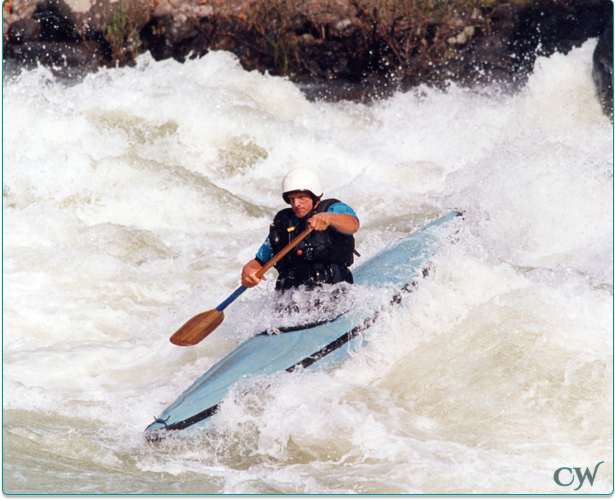
Cheat River

The Glory Days of Cheat River Rafting

In the 1970’s, long before anyone was a sponsored paddler, the only way to make money by paddling was to be a river guide. Unlike the west, where commercial and private paddlers formed very separate groups, back east, we were all part of the same community. Since there were very few skilled whitewater paddlers around, we often tagged along on commercial trips running the Lower Yough. You got a free lunch and a shuttle in exchange for working informally as an extra safety boat. It was easy to move from this to occasional employment. There were no real “standards” for guides; you just had to be known to the company manager. On busy days “known” paddlers were sometimes approached and offered work as they unloaded boats. My first day of guiding came after my car was broken into and my wallet stolen. When I tried to borrow twenty bucks from Greg Green he recommended me to his boss at White Water Adventurers instead. By the mid-70’s I also tagged along occasionally on Cheat River trips. Business here was growing fast. My friend John Brown, who guided for Mountain Streams and Trails, told me one spring that they were looking for safety boaters on the Cheat. He suggested that I come down for a training weekend and meet “the boys”. Afterwards, I signed up to work several weekends during April and May. Later that Spring I met the company owner, Ralph William McCarty.

Ralph McCarty was a man who spent his entire life “thinking outside the box.” Some people referred to him as “Crazy Ralph” because he had a unique, stream-of-consciousness way of talking. I thought he was crazy like a fox! A lot of his ideas never went anywhere, but some of them were right on target so I always listened carefully. He’d been a successful engineer in the aircraft and automotive industries of the Midwest since the early days of World War II and held several patents. He soon became better known as a riverman. He became an active whitewater canoeist, a founding member of the Mad Hatter’s Canoe Club of Cleveland, and an early instructor at the Western Pennsylvania Whitewater School. In the mid-60’s he went to Ralph Freeze at Chicagoland Canoe and bought a high-performance European inflatable kayak for his son, Mike. Since it was not a self-bailing ducky, he added a full fiberglass deck that would accept a spray skirt to keep the water out. This hot little boats was way ahead of its time

As McCarty reached mid-life he entered the outfitting business. He bought a bunch of those high performance ducks and got Chuck Tummonds, a paddler and fiberglass fabricator, to produce the add-on decks. Mountain Streams and Trails opened in 1967, offering guided ducky trips down the rivers of Western Pennsylvania and Northern West Virginia. Although his main business was on the Lower Yough, he also offered trips down the Casselman, Cheat, Upper Yough, and Lower Big Sandy! In 1968 he bought a single huge raft he called the “Black Mariah” to accommodate friends of ducky paddlers who didn’t want to paddle alone. The spaces on his raft always booked really fast, and he geared up to meet this demand. For this, he designed a unique raft were later referred to as “Ralph’s Rockets”. The side tubes extended back past a square stern to make the boat track better. A guide who knew how could use these stern tubes could climb back aboard very fast after a flip. He then contracted with Rubber Crafters of West Virginia to build them.

In the Spring of 1968 his company, Mountain Streams and Trails (MS&T) ran its first commercial Cheat Trip. His son Mike, who ran the company until 2003, was in junior high school back then. At the Albright Ball Field (now the Cheat Canyon Campground) they used a machete to cut through the thick rhododendron that lined the riverbank to reach the water. (This rhodo and the giant riverside sycamores washed away in the ’85 flood) His plan was to use the Cheat to build his spring business, when the Yough ran at levels that were considered too high for commercial trips. But the Cheat business grew explosively. By the time I arrived in the mid-70’s Cheat Season  was bigger than Gauley Season! They were running eight or more trips a day of 50 people each on weekends from Easter to Memorial Day. There was also substantial weekday business. Appalachian Wildwaters was just getting started, and Whitewater Adventurers was running a few trips, but “the boys” from MS&T had the bulk of the business. Soon outfitters from the New River, who were looking for an alternative to high-water spring trips there, came up to run the Cheat.

Guide training was informal but thorough. Potential safety boaters were evaluated by managers and senior guides as they paddled the river. A strong roll was essential and anyone who swam was likely to find himself “pushing rubber.” We also had to learn the river. It’s one thing to run the Cheat Canyon for fun, another to always know exactly where you are so you don’t direct guests someplace where they don’t belong. Experienced safety boaters were paired with rookies who showed them the “guide rocks” and “guide eddies” where we would stop to direct rafting guests away from danger and provide safety back-up. For instance, a sharp piece of metal next to the abandoned railroad bridge below the Albright Ball Field could slash a raft badly. We eddied out next to it and motioned the rafts away. If anything bad happened, we were supposed to converge on the scene to assist. The guides were expected to be excellent river swimmers, and we practiced this skill in the icy March water.

Cheat trips were run using the same “unguided format” used on the Lower Yough. The tripleader gave his safety talk as we drifted downstream from the Route 26 Bridge in Albright. He covered the difference between “small, friendly” and “big unfriendly” rocks and what to do if you fell out of your boat. He also gave the guests a “talk-up” above major rapids while safety boaters assumed their positions. He then lead his trip through the rapid. The “grunt guide” brought up the rear. He carried the group’s lunches and the first aid kit, and was the person responsible for releasing pinned boats. The safety boaters circulated around unless they had a specific assignment, assisting the grunt guide as needed. We always tried to coach the guests to unpin their boats themselves to avoid the hassle of getting out of our boats.

The Cheat Canyon before the ’85 flood was a lot like the Lower Yough, only slightly harder and twice as long. The rapids, except for Coliseum, were pretty straightforward. At the bottom of Decision Rapid people were warned by the tripleader that if they didn’t like what they saw, they should walk out. Some did, especially on those really cold spring days. Beech Run had a big hole halfway down at high levels. Big Nasty was just a big, frisky wave train with no hole. At Even Nastier there’s a pourover rock just upstream of a bad pinning rock. A raft could drop into this slot like toast in a toaster, and you might as well tie it off and wait for the water to go down! A guide always stood on this rock to warn people off and push them off with their feet if they didn’t listen. We ate lunch just below here.

Lunch was a pretty basic affair. Guests had their choice of mystery meat or PB&J sandwiches. There were apples and MS&T’s famous generic soda. Guides told me that the guests were always hungry, and good food would be wasted on them. We’d described the rest room facilities (boys upstream, girls downstream) and told them to throw their apple cores into the woods where a 90 pound chipmunk would clean up. They were cautioned against throwing lunch meat into the woods because that would make the chipmunk carnivorous, and then everyone would have to take their paddles into the woods for protection. Lastly, everyone was told “to put the top of the pop top in the hole in the pop top can” before turning in the can to be carried out. This was a good time to socialize with the guests, but we weren’t above pulling their leg. I remember one day someone asked if any of us were “licensed river pilots”. I told them my buddy Jim had been a barge pilot on the Allegheny River, but that one day his barge got away from him and rammed the Interstate 79 Bridge near Pittsburgh. “And the unemployment office sent him here.” I concluded.

After a long class III stretch known as “the Doldrums” the river starts to pick up fast. After “Cue Ball” “Green’s Hole” and “Teardrop” we arrived at High Falls, a long sloping ledge with big holes that’s exciting at any level. Years earlier John Sweet showed me a great line down the middle that always worked, but it took some courage to get out there in the center at high levels. After Maze Rapid, Coliseum approached. This rapid was quite long and really tough to guide. After going through the “Upper and Lower Box”, a series of tight chutes, the rafters had to skirt “The Devil’s Trap” and “Coliseum Rock”. Below here was  “Lower Coliseum”. This is now called “Pete Morgan” to honor a man in Albright who ran a gas station at the Route 26 Bridge. Before the days of the internet and dial-up gauge reports paddlers phoned him for water level readings. At high levels Upper and Lower Coliseum ran together. We always seemed to be about one guide short here, and people sometimes took long swims. But the guests were pretty tough in the 70’s. Most were young men in their 20’s who were hikers, bikers, skiers, or some other type of outdoor athlete. They were looking for a bit of rugged adventure, and they got it. I don’t remember any really close calls.

Rafting back then was not for the faint-hearted. People camped out at Cheat Canyon Campground, which on popular weekends was extremely crowded. Campers sometimes got pretty rowdy, forcing the campground owner, Grant Tichnell, to strap on his pistol and get things back under control. But we were an honest bunch. It wasn’t unusual to come in late at night and find Grant asleep in his chair. We’d tuck five bucks into his shirt pocket (sometimes there was quite a lot of money in there!) and enter the campground without waking him up.

The Albright Fire Department offered breakfast to everyone, and as a result of their partnership with MS&T they had one of the best equipped small-town fire departments in the country. There was no change area at the put-in, just a parking lot and a few portable toilets. But being a progressive company, we allowed the few female customers to change in a parked van or a school bus. Customer service was pretty no-nonsense, and no whining was allowed. Once, while visiting “The Last Resort”, MS&T’s base on the Lower Yough, I overheard someone tell a guest on the phone: “Now sir, I appreciate your position, but please, just remember one thing: I have your money, and you have my sympathy!”

April Cheat trips could be brutally cold, but wetsuit rentals were not available. Our management thought it would be too much trouble, so the brochure suggested that rafting guests should get one from a dive store. A few people did, and everyone else was pretty miserable. On really cold days guides took the matter into their own hands. The company had a number of huge black military surplus dry bags that we’d fill with our extra clothing. At lunch, the tripleader would issue the warm stuff to the coldest looking people. In the late 70’s an enterprising young guide named Mike Minke bought a huge bread truck and set it up to carry several hundred wetsuits. He parked in Cheat Canyon Campground and did a booming business, renting everything he had for ten bucks apiece. In the evening he’d hang up all the suits, turn on a kerosene heater, and open the top vents. The next day his suits were dry and ready to be rented again.

Mike’s business was very successful during the Cheat and Gauley seasons. He liked to party, and he would circulate around the campground with a pistol on one hip and a truckers wallet stuffed with cash on the other. Some nights he’d get pretty plastered, and we all worried that someone would try to roll him and take his money. It never happened, but raft company owners took note of his success. When they entered the wetsuit rental business a year or two later Mike was unable to compete. After a few years he and his girlfriend moved out to Wyoming. Outfitters in Maine and on the New River tell me that these rentals are probably one of the most profitable parts of their business.

One of the things about being a guide is that you get to work with all kinds of people, some of whom you hope you’ll never see again. Late each spring we got a visit from a group we called “The Gay Weightlifter’s Club”. They were all quite buff and wore bikini bathing suits. One year “Big Jim”, a tall, handsome guide, was their tripleader. At the end of the day I asked him how it went. He gave me a nasty look, then lifted his shirt. There were pinch marks all over his body! Jim was a great guide, so we were all disappointed when told us that he wouldn’t be guiding next season because he had found “a great opportunity, with a future”. It turned out he was going to be the quality control manager of a dog food plant in Connelsville! He never should have told us that! Guides barked at him for the remaining weeks of the season whenever his back was turned.

Being a river guide, if there was trouble on the river, we were expected to handle it. I always preferred to paddle with other guides because I knew if I got in trouble, they’d come after me. One day I was working my raft through Lower Coliseum when I hear my buddy Chip Queitzsch screaming for help. Chip was en engineering student at UVA and he never got excited. I grabbed a throw rope and ran like hell. Pushing my way through a crowd of canoe clubbers on shore, I saw that Chip was in chest deep water holding a guy’s head above water. His kayak had wrapped around “trap rock” in the “second box”, and his buddies were just watching the scene unfold from shore. I got one of them to hold my rope, then swam out to release the boat.

Mountain Streams and Trails had a set procedure at the takeout. Guests carried the rafts from the river to a large U-Haul truck. Here the guides sorted gear and loaded boats. Two guides balanced a raft on their heads, took a running start, and threw it into the truck. If you bounced it off the front of the cargo compartment, it was considered a good toss. If part of the raft was left hanging out the back, it was a wimpy effort. Solo tosses got you extra points, but you had to be quick! Sometimes the raft would catch the back of your head and slam you into the truck bed, so I always kept my helmet on. A crowd of guides would be hanging around to critique your performance. For many years no one on the Cheat would hire women as guides, supposedly because they weren’t strong enough to chuck the rubber. But when I worked at Nantahala Outdoor Center in ’74 we had a number of excellent female guides, and we loaded rafts pretty efficiently. I still remember encountering U.S. Team member and NOC Chatooga Section IV guide Lynn Ashton in Ohiopyle after she had been turned down for work on the Yough. She was especially furious because her much-less-skilled boyfriend was hired.

Actually, in the late 60’s Mountain Streams became the first river company to hire woman and minorities. Greg Green (who later started the first successful river photography business) joined Sue and Cathy Spindt living at the company headquarters in town. This “progressive” living arrangement did not set well in town, and their lease was not renewed. Greg continued to work on the river for various companies as the first active black guide, but no other women were hired until the early 80’s. Now they are guiding on all of the major eastern rivers and we wonder how we managed without them

We always told our guests that the shuttle ride at the end of the trip was as wild as the river. And we weren’t kidding! Anyone who’s taken a trip up the Masontown side of the Cheat takeout at Jenkinsburg knows how steep and narrow that road is for any vehicle, much less a school bus! I kept my helmet on, and so did lots of other guides. Several times the bus seemed to span precipices as it negotiated the tight turns. We did this because the road on the Valley Point side that we use today was in very bad repair. Going out this way required a high-clearance four-wheel drive vehicle and a sense of adventure. The infamous “mud hole” at the top of the gorge was the crux move: you just gunned it and charged through a hundred yards of door-deep slop and hoped for the best

On busy days we stationed someone at the top of the hill on the Masontown side and used CB’s to make sure that two buses wouldn’t meet part-way down. Sometimes locals would blow through the traffic checkpoint and go on down anyway, causing a huge traffic jam. Once some guys from Masontown who were fed up with all this activity drove an old clunker of a car down the road, broached it in a narrow spot, and abandoned it. Guides from several companies, lead by a tough local man who was driving the lead bus, got out and manhandled it off the edge of the cliff! MS&T eventually switched to using vans, driving guests to the top of the road and transferring them to buses.

Eight trips a day with 44 guests each, plus guides, means that there were a lot of people to move around. When things went well, it was easy enough. Each tripleader had a scheduled finish time, and by hurrying up or slowing down over the last few miles you could meet your goal easily. But occasionally there was a bad pin on the river that threw your schedule off. Sometimes the rescue involved not only your own guides, but the guys from the next couple of trips. Now everyone arrived at the takeout simultaneously, and there were more people needing rides than the busses could handle. A broken-down bus could cause the same problems. This always seemed to happen when the weather was really bad.

He had maneuvered his way into working a trip composed of high school girls from Fairfax County, Virginia. They were cute, but also very under age. Dave was determined to impress them, and the delays at the takeout gave him the perfect opportunity. Now, understand me, a few guides jumped from the 50 foot high deck of the Bridge at Jenkinsburg, but most of them hung by their arms from the deck before letting go. Dave announced that he was going to jump from the superstructure of the bridge, adding about 30 feet to his leap. Very few people had ever done this, and nobody did it twice. As a crowd gathered, he reached the top and took the plunge. He came up screaming. His legs had apparently parted slightly during the fall; he was wise enough to protect his privates, but the water found another venue, He was rushed to a hospital in Morgantown to have his underpants removed from a place where the sun never shines!

I was part of a group that would sign up for the early trips so we could take a fast, sweet run down the Big Sandy afterwards. We ran our shuttle the night before, leaving a vehicle in Jenkinsburg. The next day we’d load our boats after the trip and go, planning to get to the takeout in time to ride out with the equipment truck. Usually my Dodge Power Wagon, the designated shuttle vehicle, was crammed with more people and boats than it could safely handle. Once, bouncing up a particularly bad spot in the Valley Point Road, the wooden rack frame over the pickup truck bed broke. The people riding underneath screamed, but stopping was not an option. Afterwards we jury-rigged a repair, finished the shuttle, and made the run.

If nothing else was running, we’d hang out at the put in until it was time to get dinner in Kingwood. The company rented the second floor of an old stone building that in it’s past life had been the bank. It became known as “The Cheat Suite”, the weekend guide’s home away from home. It became filthy as only guide quarters can be. You couldn’t drink the water, but at least the toilets worked. Unless the weather was really awful I preferred to camp out! One night I was there when my friend Chip brought his very attractive girlfriend Bette there. I sat and watched in amusement as several different guys came into the room, saw her, then walked right into the narrow edge of an open door. Ouch! The place got a little worse every year. After I stopped guiding, MS&T built new guide quarters. This was a windowless structure across the street that everyone called “the mailbox”. Appalachian Wildwaters later rented the old bank and tried to open a bar there, but rowdy locals tore the place up so badly that they couldn’t make a profit.

One afternoon turned into a guide’s workday from hell. Everything went wrong, and the end-of day shuttle was horribly late. As usual, all the safety boaters had loaded their boats on the ducky trailer, a relic of our company’s past history with inflatable kayaks. On the way out the trailer lost a wheel. It fishtailed over the edge of the road, and several kayaks broke loose. These quickly slid into the depth of the Bull Run gorge. It was getting dark. Running around with flashlights, we managed to find all the pieces and get rolling again. After an 11 PM dinner at the Pizza Hut in Kingwood, we got back to base and crashed. The next morning Ralph McCarty, a notorious early riser, arrived at our camp at dawn. He was annoyed that the ducky trailer was not unloaded as it was supposed to be, and moved around camp to wake people up. Dan, his own manager, told him to get lost!

One year a bunch of strangers came to town. They swaggered around, told everyone they were “Lehigh Guides”, and generally seemed quite pleased with themselves. But the boys at MS&T weren’t impressed. “The Lehigh’s not a real river, it’s a damned float trip” someone said. Having already been harassed for being affiliated with the Philadelphia Canoe Club, which my guide buddies called the “Philadelphia Swimmin’ Club”, I kept my mouth shut. The Lehigh Guides asked to tag along on our trips, and we obliged. We lead them down tight side chutes ending in holes that we’d cut away from at the last minute. We’d also try to get them to play in some of the Cheat’s nastier holes. A favorite was “Fool’s Hole”, located in the Doldrums. It didn’t look like much, but oh boy, was it deep! If you surfed across it quickly, you could make it look easy. One of us would make that move, then sit back and watch the fun.

The Cheat Canyon is a wild ride at high water, and it was way too nasty for guide assisted trips. Our cut-off off was four feet at the Albright Bridge. If the water was higher, we moved the trips upstream to the Narrows. Normally a Class III run with one easy Class IV drop, at eight or nine feet this stretch gets awfully pushy. There are huge waves and some very large holes. Keeping track of a group of self-guided rafts, let alone rescuing someone, was pretty challenging. Safety boaters towed swimmers to shore and advised them to walk downstream to the takeout. We then peeled out and rushed downstream to help someone else.  The run was over very quickly, but some guests felt that it was quite long enough.

Eric Nelson, owner of Cheat River Outfitters, was on shore with his movie camera one day as one of our trips headed into Calamity Rock Rapid. He caught a boatload of turban-wearing Sikhs, from India, as they were thrown head over heels by the big crashing wave at the bottom. As they flew out of the boat, their turbans unwound! This film was played back often over the next few years. Guides hanging out at Cheat River Outfitters’ base watching home-made boating movies would start to chant, “Swam-is, Swam-is!” until Eric loaded that film. Then we savored multiple slow-motion replays. This film, like so many other good things, was lost in the 1985 flood. After Mountain Streams started running the Gauley they realized that the Rockets just weren’t big enough. So they bought a fleet of huge black 16-footers that they called “BFR’s”. These “Big Fat Rafts” were terribly heavy, but very stable. Naturally, they saw service on the Cheat at high water with a guide in each boat. These trips were a lot easier on the guests.

The Cheat was known for rapid changes in river level which, as some locals ominously said, would “cheat you outta your life”. One year in early June, 1980 (when, fortunately, I wasn’t working) the river rose from 2.5 to over 14 feet in less than twelve hours. At nine o’clock, with the gauge still reading a relatively reasonable seven feet, trips headed for the Narrows. The water was even higher in Rowlesburg, and they got in trouble soon after launching. Safety boaters recovered everyone but a man who was marooned on a midstream rock. This rock is on the shoreline at normal water levels. John Lichter, MS&T’s river manager, kayaked out to him. He decided that he could not pull the man to safety with his kayak because there was a bad strainer just downstream. To add insult to injury, the water was still rising. The rock was covered with snakes, who fortunately were too terrified to cause any trouble. Fortunately, a coal company helicopter was in the vicinity. The pilot, a Vietnam veteran, made a daring one-skid landing on the rock and picked up the stranded guest. Management moved in quickly and cancelled subsequent trips.

Low Water created its own problems. As the level dropped, the current slowed, and the trip took a lot longer. In addition, there were more rocks to hang up on. Guests and guides got tired and cranky. One day, after finishing trips at very low water levels, we heard a commotion from the Cheat River Outfitters base. A group of huge men were trying to bully Eric Nelson into refunding their money, which he had already spent! They backed down when a large group of guides from both companies barged into the room to offer Eric support. On another day Jim Colianne was having problems with a raft that was being paddled by four huge men. They kept hanging up on rocks, and there they would sit and scream at the guides to pull them off. Late in the day their raft hung up on a rock one more time. Jim pulled into an eddy, hopped out of his C-1, and told them to get out of their boat. This they did, figuring he was going to pull the raft loose. The grunt guide pulled alongside with a mischievous expression on his face. Before the rafters realized what Jim was doing, he popped the valves and deflated their boat. “You’ve seen the streams,” he said as he rolled up the boat, “Now it’s time to hit the trails. Trail’s right over there. Watch out for snakes.” He threw the raft into the grunt guide’s boat and paddled off, leaving the speechless men to find their own way downstream.

Often on weekends I’d meet my old racing buddies who razzed me about “selling out”. “Guides are like whores,” they said, “first they do it for fun, then they do it for their friends, and then they do it for money.” I didn’t care. I was being paid to paddle. We learned to play the river in between the rafts, sometimes closer than we should. To this day I don’t mind mixing it up with my rubber buddies. At Boulder Line we’d do enders between oncoming rafts. Occasionally a guide’s timing would be off and he’d land on top of the raft. This was one way to get in really big trouble with your tripleader.

Although many guides had fantasies of romancing a female rafting guest, it almost never happened. Single girls didn’t go rafting much, and if they did, most had better prospects than the likes of us. John Connelly was an exception.  His blue eyes and charm allowed him to succeed where others failed. One day he made a play for a lady, but things didn’t look good. We razzed him unmercifully at the takeout and on the bus ride back. But shortly after we got into Albright, the lady pulled up in a sports car with a bottle of wine looking for John. He smiled broadly at all of us as he hopped inside. Years later he started Eastern River Expeditions, which became the second-largest company in Maine. After Gauley Season he drove up and ran the Kennebec and Penobscott Rivers solo, then returned home to raise the capital he needed to open his business. The same salesmanship that he used to convince his guests that they were having fun on the Cheat at low water served him well in his new endeavor!

Memorial Day was the last big rafting weekend on the river. To celebrate, Mountain Streams and Trails and Cheat River Outfitters threw a huge guide party on Sunday. The only downside was that we had to work the next day. One evening, on the way back to our camp, my buddy Jim and I tripped over “Fish”, our river manager. He was lying semi-conscious in the grass, his eyes wide open. I never knew what “pie-eyed drunk” meant until that night. We were afraid that someone would back a car over him, so we took him to his van and laid him out, face down, under a sleeping bag. We had to work the 8:00 trip, and thought that we’d have to find the keys to the equipment truck and inflate all the boats by ourselves. But the next morning we awoke early to the sounds of raft blowers. Fish was hard at work, looking fresh as if he’d gone to bed at 9:00! Another time a group of us decided that Chris Walters was too drunk to drive back to Ohiopyle, and tried to take his keys away from him. We chased him all over the campground for thirty minutes. We tackled and manhandled him many times, but he fought us all off. We finally decided that a guy who could elude a dozen of his buddies was probably sober enough to drive.

In 1985 much of West Virginia experienced catastrophic flooding. The Cheat River crested at 26 feet (roughly 250,000 cfs), wiping out half of the town of Albright. Many residents had only a few minute’s warning before their homes were inundated. MS&T’s Cheat Suite and all the buildings around it were leveled. Cheat River Outfitters was washed away, too. Eric Nelson evacuated some of his gear by truck, but stopped when his wife Peggy told him that she just couldn’t stand watching him cross the Route 26 Bridge, and if he did it again she would divorce him! Pete Morgan’s gas station at the Bridge was flattened. Appalachian Wildwaters lost half of its building. That evening the owner, Imre Szylagyi, took a canoe and paddled into his office to retrieve computer tapes and vital papers before they were carried downstream. The water rose to the eaves of the building at Cheat Canyon Campground and took out all the magnificent old sycamores that lined the riverbank. The water kept rising, cresting over the Route 26 bridge and depositing a 5’ diameter tree across the roadbed. There was so much debris in the river that the spillway at Lake Lynn Dam, which holds back Cheat Lake, was almost blocked. Had that happened, the dam almost certainly would have been lost.

When the water fell, devastation remained. You could see the power plant from the Route 26 Bridge where buildings had blocked the view before the flood. Outfitter busses were found lying on their sides along the road leading into Albright. Rafts and T-shirts were caught in the trees and bushes lining the river for miles downstream. The banks were scoured twenty-five feet above the normal high water mark, carrying away thick growths of rhododendron and mountain laurel. Huge rocks were rolled. Many of the Cheat Canyon’s rapids were changed. Coliseum Rapid was completely remade, and continues to be altered as time passes. It has become a very challenging rapid! Green’s Hole above High Falls was washed away.

At high water a huge hole developed in Big Nasty Rapid where none existed before. All the pre-season training in 1986 had been at moderate water levels, so no one knew it was there. Then, on a day known afterwards as “Black Saturday”, guided trips encountered the hole for the first time. The monster flipped almost three-quarters of the boats on the river, and juggled two or three rafts with ease. As a result of experiences here, and at Coliseum Rapid over the next few weeks, companies abandoned the guide-assisted format and put a guide in every boat unless the water was very low.

Despite the suffering and loss of life, the flood was an amazing event. I’ve never seen anything like it. I heard that an archaeologist tried to return to a site that he had been working on in the Seven Islands section, way upstream near Parsons. Objects recovered from there had been carbon-dated and found to be several thousand years old. But when he returned, the island was gone! As a boater and a guide, it was amazing to see how this huge event changed a river I knew so well. Many of us mourn the destruction of “the old Cheat”, but I have come to enjoy it’s successor just as much.

Nowadays the Cheat rafting season is a shadow of it’s former self. Where once sixty thousand guests ran the river each year, now barely a tenth of that number go down. There are many reasons for this. The T&T Mine Spill in 1990 sent filthy water roaring down the river and gave the river a whopping dose of bad publicity. Thanks in a large measure to the efforts of the Friends of the Cheat, the river has made a strong recovery. But when self-bailing rafts became popular companies that offered summer trips on the New River Gorge realized that they could now run the river at high spring flows. They abandoned the Cheat and developed lavish New River Bases, which feature hot showers, heated changing areas, restaurants, bars, and other amenities. Spring rafting, in general, is on a decline throughout the East. I’m told it’s hard to market a river that is at a nice level one weekend, then goes way higher or lower the next.

Today the Cheat Canyon has changed very little from John Berry’s pioneering canoe run in the mid-60’s. As a rafting river, the Cheat is West Virginia’s best-kept secret. Challenging at all levels, it remains wild and unpredictable. This makes it rewarding in ways that dam controlled runs will never be. Come in March, when the hillsides are often streaked with snow and ice! Come in April, and see the Redbud and Serviceberry brighten the dark brown hillsides. Come in May, and watch as the delicate green leaves of spring become the thick growth of summer. Then in June, after heavy rains, the river roars past sandbars covered with colorful wildflowers and thick stands of blooming rhododendron and mountain laurel. For kayakers, there’s plenty of big, uncrowded water and challenging play spots in a beautiful canyon! Don’t miss it!

Gauley Season- The First Ten Years

I’ve always enjoyed other people’s stories of their first runs of the Gauley River, but they’re very different from the early days I knew. John Berry tried to run the river in open canoes sometime before the dam during the mid 60’s and Sayre Rodman made the first successful run in rafts in 1966. The first closed-boat run of the river was in the summer of 1968 and in the next couple of years a handful of boaters followed. My first run on the Gauley was in October of 1971. A recent college graduate, I’d been hired to teach seventh grade Biology in the Washington, D.C. area. I’d taught myself to paddle with friends in a college outing club, first in open canoe and then C-1. I was looking forward to trying new rivers, and I had deliberately moved into this vital center of East Coast whitewater paddling.

Back then racing was a great way to meet good boaters. I’d heard about the Gauley and was interested, but wary. The river was spoken of respectfully by John Sweet, Tom Irwin, and the other Penn State paddling gods I’d met at the Loyalsock Slalom. Then at the Fall Savage Race I got into a team run with Ed Gertler. After the run he asked me if I was planning to run the Gauley. When I questioned my fitness, he admitted that he was tripleader for the CCA and that he thought I could handle it. That was all I needed to hear. I think this was the third “club trip” to run the river.

Twenty-two years ago the West Virginia highway system was a bit more basic. Route 19 did not exist in its current form, and its junction with Route 60 was a battered meeting place of two-lane country roads. Coming in from Clifton Forge at midnight, I had to get out of the car, push the undergrowth aside, and read the faded road signs with a flashlight. We found Summersville Dam at 2 AM after getting lost several times. There were only a handful of us, so the Corps let us sleep in the pavilion near the playground. The next morning sixteen of us from CCA met Ed and Barb Brown in the gray morning mist at the base of the dam. In addition to the hard-boaters, John Dragan’s Wildwater Unlimited was running a few of his rafts down. At the time he was the only outfitter on the New River, and he was doing the Gauley with some of his most experienced customers. A handful of others put in later. No one else was there.

The rapids at first seemed powerful, but manageable. I was doing fine until Pillow Rock Rapid. We scouted, but I had no idea what I was getting into. Once in the rapid, I found out too late that it was the biggest water I’d ever seen! I ran up against the big pillow near the left-hand rock wall, flipped instantly, and swam. My foot caught in a thigh strap; the C-1 went to one side of Volkswagen Rock and I went to the other. I got dragged over the top of the rock and was driven down to the bottom of the river like a pile driver. I guess I was too stupid to let it shake me up.

The only takeout we knew of was the railroad bridge at Peter’s Creek. It made for a long day, especially with swimmers in every major rapid. We portaged Iron Ring without question, noting the corpse of a horribly battered deer in an eddy below. Approaching Sweet’s Falls, I was warned in no uncertain terms that the hole at the bottom was an absolute keeper. Bill Funk had kayaked the drop the previous year, but he refused to discuss his route. He said only that the line was only 6″ wide and to miss it meant certain death. As we approached, mist rose up from the lip of the drop, turning my bowels to jelly. Terrified, I grabbled the center eddy and hustled carefully over to the far-left chute. I’d never seen anything so mean-looking!

Below here, it was a hard push to make the tracks before sunset. Koontz’s Bend passed quickly, since we were too tired to play. I finished the day physically exhausted and mentally drained. I wasn’t sure that I ever wanted to do that again! The Lower Gauley the next day was easier, but I came around a corner and found an eddy full of boats. A swim of Lower Mash followed. After a tough run I’ll close my eyes and see the river unfold ahead of me. I rode home dreaming of enormous holes and waves. Soon I forgot my fear and looked forward to getting back.

Pillow Rock was my nemesis. For years no one knew how to run it, and almost everyone rolled or swam. I was always pleased to roll back up, but stayed in my boat only half the time during the years it took me to figure things out. All this aquatic activity, combined with the words of Idaho’s Dr. Walt Blackadar, inspired the development of the HiFloat Life Vest. In later years as more people came to the river the show continued unabated. I started running without air bags because I felt it gave me “added incentive” to roll. On one run of Pillow, I popped my sprayskirt halfway down. The stern quickly filled with water, and a decade before the first squirt boats, I paddled my Hahn vertically through the big waves. It was only when the boat started to sink that I decided to bail out.

I continued to sneak Sweet’s Falls. Boaters gradually learned that the “killer hole” was an exploding wave in disguise. Dragan at first lined his rafts, empty of customers, around the drop, but eventually the rafts started going over. A few hard-boaters made the run, then many. Intimidated by first-run lore, I was one of the last holdouts. I was scouting Sweet’s Falls one afternoon when Susie Lilly, Barney Lilly’s 15 year-old daughter, came up and asked me how to run it. I told her that I didn’t run the drop, but pointed out the line. She smiled, said “O.K.”, and skipped back to her boat. She ran the big ledge almost sideways, bouncing off of what is now called Dildo Rock and flipping in the frothy mess at the bottom. She quickly rolled up, yelled “Whoopie”, tossed her paddle, and continued downstream. I figured I could paddle at least as well as that, and while the drop still scares me I’ve been doing so ever since.

Iron Ring retains an evil reputation as far as I’m concerned. During the early years few ran it and many carried. On my second run only Jim Snyder, 16, handled it with any style. Now the situation is reversed; almost no one makes that portage. Lee Belknap showed me the line, and I ran it a few times in the early 90’s. Even though the drop is easier than it looks, I still walk. The Gauley makes me awfully mellow, and all that adrenaline would ruin the mood. And I just can’t get that dead deer out of my mind.

We kept hearing rumors of plans to dam the river. We expected a big political battle, so strange as it might seem today, several of us conspired to lure more boaters to the river. I wrote about the Gauley in the AWA Journal in 1972, and several of us offered to guide groups down the river the following fall. In 1973 I took sixteen Southeastern boaters down the run, including Claude Terry and his son, Mike. With only two runs under my belt I didn’t know the river all that well, but I felt comfortable moving from eddy to eddy. Making a key stop above drop two of Lost Paddle, I was immediately pinned to the shore by a horde of following boaters. I had to fight my way through the crowds to peel out into the next drop. Mike Terry was fearless and I spent the day wondering if he was going to kill himself. His attitude would be more normal today.

One of the things we did was sponsor a downriver race from the top of Mash to the pool at the base of Pure Screaming Hell in the late ‘70’s. I tried it once, but decided that the Gauley was a thing of beauty to be savored, not rushed. Wally Dyer and his partner, Ben Cass, were a top-ranked doubles team from Philadelphia. Wally was an intense, competitive man, but not exactly a big-water paddler. Naturally I delighted in telling him all my Gauley River horror stories before his first race. Looking at the starting list, he saw a pair listed he didn’t recognize. He turned to me and asked pointedly, “Who’s this Singley and Wilkinson?” Now these folks were friends of mine, a couple from Blacksburg who raced in the men’s class because there weren’t enough boats around to form a mixed division. But I made up a story about a hot British team that had won all the races in Canada that summer. I though Wally was going to swallow his trademark cigar! Later his partner came to me and begged me to lay off Wally so he could get some sleep.

For the next few years the numbers of paddlers steadily increased. The boating community was tiny, and the quantity of Gauley Boaters smaller still. But you didn’t have to arrange to meet someone to have a shuttle. We knew who was there by the types of cars at the parking lot. We could tell who was paddling at a distance by the colors of their boats and gear. If we didn’t know you and you weren’t with someone we did, you probably didn’t belong here. One year two small, inexpensive rafts were beached below Insignificant, their floors ripped out from under them by the force of the water. Another year saw a horribly mangled Blue Hole canoe washed on the shore near the head of Pillow Rock Rapid. We chuckled knowingly at these wrecks, and paddled on.

Suddenly  the numbers jumped from dozens to several hundred. For the first time there were lots of people around who I didn’t know.  But most of them were capable boaters who handled the river with class. All these new people were something of a shock to the old timers. There were three very attractive women serving as shuttle bunnies for a group from South Carolina. We got down to Lost Paddle only to find them nude sunbathing on rocks dispersed throughout the rapid. Definitely unsafe, we agreed. Could cause accidents!

We outgrew the capacity of the pavilion at the top of the dam. One weekend I arrived in a driving rain. The pavilion was jammed, and we spent a sleepless night greeting new arrivals and telling lies to each other. The next day a few idiots backed their cars over the saturated lawn to load their gear. They got getting stuck and left huge ruts. This motivated the Corps to keep Battle Run Campground open in future years, and we were banned from the pavilion forever.

That morning the Gauley was running at 5,000 cfs and the Meadow was putting out 10,000 or so. Route 19, which we called “Corridor L”, had just been completed. Many folks hiked into the Lower Meadow to view the chaos. I left before Bart Jackson was hit by a car as he wandered lazily across the road. Just before impact he saw the speeding vehicle and jumped into the air. He rolled across the hood and landed unhurt to one side. The terrified driver was quite relieved to find out

The few who tried the Gauley had wild stories. Tom McEwan hit the hole in the bottom of Pillow Rock and lost his helmet and glasses. He carried out. “Fearless” Fred Young and his group of Midwest maniacs ended up carrying all of Lost Paddle Rapid along the railroad tracks. Lower down Chip Queitzsch, a fellow C-boater, was surfing a big hole at Koontz’s Flume when he caught sight of his air bags floating downstream. The seams of his fiberglass boat had parted, and he and his boat soon followed the bags! Later the day turned bitterly cold. After looking at all the flooded upper tributaries, we settled on the North Fork of the Cherry only to get snowed on. I stayed up in the headwaters for the rest of the weekend.

Commercial rafting on the Gauley began in the mid 70’s. The owners were people we’d boated with, and we weren’t shy about telling them that they were making a big mistake. I remember sitting in eddies with my buddies in Lost Paddle, chuckling as those big rubber boats swamped and floundered, totally out of control. Their sweep oars broke, the guides lost control, and guests fell out of the rafts by the score. Pure entertainment! We felt that they’d never be able to make rafting on the Gauley a success. Today, as the guides hold their smooth, precise lines through the rapids, I realize that we underestimated, as usual, the ability of river runners to improve their equipment and skills. I certainly never visualized the crowds that we have today.

Originally we left our boats at the mouth of Peter’s Creek, walking in along the tracks and back out the next day to run the “Lower” down to Swiss. After several people had boats stolen some of us began leaving our craft above Koontz’s Bend and walking out through the mile-long tunnel under the ridge. This split the river distance nicely, allowing us to run the great play rapids of Koontz Bend at the beginning of day two. But the walk through the mile-long tunnel was spooky at best. It took us about twenty minutes to walk through. We almost never remembered to bring flashlights, so we stumbled about in the dark, stubbed our toes on the ties, and floundered in the filthy puddles all the way to the other end. One clown brought a small compressed-air horn and almost scared us to death! I never got caught by a train, but those who did described in detail the unpleasantness of lying face down in the mud as the cars roared by, close enough to touch. Even though the road is unsightly, I wasn’t totally unhappy to see Appalachian Whitewater’s develop an access at Mason Branch.

Another year we were hanging around at Swiss waiting for our shuttles. Not knowing that railroad cars stick out well past the tracks, two fools had parked their vans right next to the rails. A local man drove up and said, “You’d better move them things, ’cause there’s a train a-comin’, and they wrecked some feller’s car last week.” Spurred by the approaching whistle, we did what we had to. One van was easy; we broke in through the side window, released the brake, and pushed it away. The second one we found to our horror had a locking steering column. We got all the people we could find, thirty or forty strong: boaters, guides, customers, and the local man who’d warned us. We grabbed the van and muscled first one end over, then the other. The front end was really heavy, and we had to bounce and skid it a few inches at a time. Nowadays we pay a few bucks to various locals who watch the cars during the day.

The commercial rafting business on the Gauley Continued to grow. Today the need for extra guides is met by hundreds of Western boatmen who travel east for Gauley Season, but during the late 70’s it was not unusual for company managers to cruise around the paddler camping slots below the dam looking for guides. They would offer $120 or more to experienced paddlers who would “push rubber” for a day. That was real money, but I came to play, and the idea of being on the Gauley in a boat full of guests made me nervous.

But while the crowds are a nuisance, they helped save the river by turning it into a major tourist attraction. Dave Brown recalls being ushered into West Virginia Senator Byrd’s office on Capitol Hill. This was the beginning of the Reagan Era and this venerable politician told him that he “didn’t have much to give to environmentalists today.” Brown countered by explaining that outfitters were bringing over $10 million into the area during the four week Gauley season. That got the Senator’s attention! The efforts of AW and Citizens For Gauley River, which coordinated opposition to the project from kayakers, outfitters, and local businessmen, eventually bore fruit. There’s much to do, but in theory the river and its flows are protected.

By the mid 1980’s the scene had changed. The season moved from October to September, trading the majesty of changing foliage for warmer air temperatures. Traffic increased. Cars entering the parking lot below the dam were tightly controlled, and traffic jams at other access points became normal, not unusual. In previous years the area below the dam was like old home week, a huge reunion of East Coast paddlers. Now, rather than seeking out the places where boaters congregate, I tried to avoid the crowds by using off-peak put-in times and access points.

But the crowds are not the whole story. The Gauley during the Fall is an amazing display of the latest high-tech plastic and rubber gear. People have surprisingly good skills, and swims are rare. Innumerable access points and lunch stops, complete with tents, cooking facilities, and graded roads have taken away the wilderness feel. The river is more accessible, and untold thousands have gathered strength and sanity from passing through. But something very special has been lost.

While I still enjoy the river immensely, I miss the wildness we found in the 70’s. The precious sense of exploration and wonder felt by our small, self-reliant groups as they moved carefully and respectfully down a wild, trackless canyon seems indescribably distant today. While I regret the loss of the marvelous camaraderie we shared in the days when everyone knew each other, I meet new people who become friends every year. And if you put on late in the day, when most of the other boats are nearing the end of their run, the years slip silently away, and the solitude and majesty of the Gauley Canyon returns and closes in around you. Get some friends together, and enjoy!


Charlie Walbridge Swifwater Rescue Instruction Whitewater Consultant Ohiopyle, Youghiogheny, Cheat Big Sandy, NRS Salesman

Getting Started Paddling (True Confessions of an Old-Time Boater)

Nowadays it’s easy to run down to a store, buy a kayak, or take classes at a local kayak school. But years ago starting out was different. This is my story.

It’s the summer of 1962, I’m a 14 year-old at Mowglis, a boy’s camp in New Hampshire. We’ve been floating down the Saco River for a day and a half now, and we’ve just arrivedWalker’s Falls. This rapid is really not more than a Class I or II, but to our group, it looks tough! We scout it carefully in the warm sunlight. Mr. Abbott says we’ll have to run down the right-hand chute, then cut to the left to avoid hitting a big rock at the bottom. I’m thinking that I really don’t know how to steer.

One by one we head back to our aluminum canoes. We have battered wooden paddles and no life vests. One or two of our boats make it through upright, but most broach against the rock at the bottom and capsize. I’m at the end of the line with my partner, Danny. He’s the best canoeist in camp. He’s also the smallest kid in the group. I’m the biggest, and he got paired with me because I’ve never canoed before. Mr. Abbot wants told him to paddle bow, where he has no control over what’s going to happen. He doesn’t like it. I’m too scared to steer as we slide down the chute. Before I know it we’ve hit the rock head on. The bow flies up, and we’re teetering on the rock. I throw my weight forward, and we slide down the other side, upright. The guys say that’s cheating. I’m tired of sand in my gear and soggy wet feet. I think I’m going to stick to backpacking.

Fast forward to the fall of 1966.  I’m in freshman orientation at Bucknell University in Central Pennsylvania. I’ve just run into this guy named Marty in the cafeteria. He’s tall and skinny, with wild red hair and slightly bugged out blue eyes. He’s way into Tolkien and has a zany sense of humor. We find out that we’ve both been working as camp counselors in New England for the past few years. My camp did lots of backpacking in New Hampshire’s White Mountains; his did long canoe trips in Northern Maine. Bucknell doesn’t have an outing club, and we think it would be a good idea to start one.

Move ahead to the Spring of 1967. The Bucknell Outing Club is up and running. I’ve been pretty distracted by freshman football, but I’ve also done enough hiking in the area to know that it’s not very exciting. Marty has been canoeing a lot, and he talks me into doing an overnight on Penn’s Creek with him. Dr. Nicholson, our faculty advisor, likes to canoe, and he recommended it. Somehow we scrounge up a couple of Aluminum canoes and a two-man Klepper Foldboat. By mid-afternoon we’re in Coburn, loading the boats.

I’m paired with Dave, only this time I’m in the back because I’m the one who’s canoed before.  I’m still not really sure how to steer. Except for a few minor rapids in New Hampshire, this is my first whitewater trip. Marty and Jim hop into a canoe and along with Bob, who’s paddling the Foldboat, they leave us far behind. But it’s a sunny day, and we’re doing just fine. We’re floating down a deep valley, and the trees are just beginning to bud. “This is wonderful,” I think, “you get to see all this great country, and you don’t have to carry a pack.”

We run into the rest of the group about five miles downstream, where the river makes a wide loop. The rapids are harder here, probably Class II. Dave and I start down and quickly get stuck on rocks. We hop out, pull it off, and quickly broach again. We decide to wade and drag our canoe along the shore for a while. It’s getting late, and the water is really cold. Eventually the river calms down enough and we can get back in. We make camp in the woods by a long pool.

The next day, disaster strikes. Bob and his foldboat get swept underneath a tree. We wrestle the boat loose, but he’s looses his camera and binoculars. Just below here Dave and I pin our canoe on a rock. The boat takes a while to get free, and all our gear is soaked. Dave and I are so rattled that we want to hike out. Marty and Jim split us up. Marty put me in bow, and after a few minutes I settle down. We reach the takeout at Glen Iron with no further problems.

The next year I got pretty sick and dropped out of the University for a year. In my absence the Outing Club got some student activities money and bought two aluminum canoes and some paddles. I hadn’t forgotten that trip down Penn’s Creek, and wanted to do it again. I even went out and bought an aluminum canoe for myself. There were no guidebooks, so we pulled out some highway road maps and decided to go exploring. My regular partners that year were Eric, a quiet, curly-headed blond guy on the verge of flunking out who was my tandem partner. Our buddy, Bill, was a very solid canoeist who preferred to paddle solo.

In the spring of 1969 we did some 50+ mile day trips down Pine Creek and Loyalsock Creek below Forksville. I’m still recovering from my illness, and it felt good to float those easy riffles and long pools in the warm sun! We ran tiny Baab Creek down into Pine Creek and stuffed three canoes underneath a downed tree! Later we tried to crash our way down the Loyalsock above World’s End State Park at low water. It was an honest Class III, or so we thought. The high point of the trip was running “The Sluice”, a break in a three-foot high dam that creates a swimming hole in the park. The big waves in the run-out could swamp your canoe in a second, but Sharon showed us all how to stay dry by back paddling as you headed into them.

There was a slalom race under way when we arrived at the Loyalsock a week later. We’d heard of kayaks, but we’d never seen any as sleek as these. And those racers sure knew what they were doing! We hung out and watched. I bought race programs and talked to people. A couple of the guys bought used kayaks right there. I wrote to an address I found in the Racing Program and joined American Whitewater. I also saw an ad for Klepper Kayaks. A few weeks later I went to New York, talked my mom into driving me down to Hans Klepper, and blew my summer savings on a shiny new red Trabant kayak, a nylon sprayskirt, and a wood paddle that I broke the first time I used it. I could barely fit inside!

That fall the Outing Club decided to run some pool sessions so we could learn to roll our kayaks. The fact that none of us knew how didn’t discourage us. After all, we had the AMC Whitewater Handbook! The first obstacle was Coach Reynolds, the Athletic Director. He was the swimming coach, and thought that this idea sounded pretty hare-brained. No one was going to take a bunch of dirty kayaks into HIS pool! But Dr. Nickelson, our faculty advisor, was the chair of a committee titled “The Place of Sport in University Life.” He was spearheading  an effort open up athletic facilities to non-varsity athletes. He told Coach Reynolds that if we didn’t get some pool time, he’d bring the matter before the Dean. We were grudgingly offered a slot from 7 to 9 AM on Saturday.

After several weeks of flailing around a few of us were able to awkwardly roll our kayaks back upright. It was pretty precarious. Then one night I got a call from my buddy Jim Love. “We’re doing it all wrong!” he said, “Come over here and I’ll show you.” Later I watched and listened as he contorted on the floor with his paddle, interpreting the sketches in the Whitewater Handbook. It looked improbable on dry land, but it worked great under water! Now our rolls started to have some snap!

I wrote to the Penn State Outing Club, sponsors of the Loyalsock Slalom, and asked for help in getting started in whitewater racing.  The letter was passed around and eventually answered by someone named John R. Sweet. I didn’t know it at the time, but Sweet was national C-1 champion and a very hot river runner. Sweet’s Falls on the Gauley is named for him. His group included a bunch of nationally ranked racers and US Whitewater Team members. But he invited us up to his pool sessions in State College, which, looking back on it, was an amazingly generous thing to do. After all, he didn’t know anything about us except that we were some college kids who said we wanted to race. I told him that we’d been breaking the paddles we’d bought from Bart Hauthaway and Stu Coffin, and he recommended the Norse Paddle Company. Those sticks were heavy but tough, exactly what we needed!

Jim Love and I made the one-hour drive from Lewisburg to State College together every Sunday, all winter long. Those PSOC-ers were impressed that we could roll, and took time from their training to coach us. Dave Kurtz invited us up to the Wildwater Boating Club boat building shop in Bellfonte to watch some people build their kayaks. I spent half a day helping one of them build a C-1. Later Jim and borrowed a mold and laid up a Prijon Special Slalom in his basement. During Spring Break I went to an Army-Navy store in Brooklyn and bought two shortie wetsuits for $35 each. I also ordered a couple of waterproof tops from the Dartmouth Co-op and bought some hockey helmets and inflatable life vests from Bart Hauthaway. We were ready for spring!

Jim had just finished building his kayak, and was anxious to put it on the water. I came home from spring vacation a day early in a hard, wet snowstorm. We geared up at his house and drove down to McKee’s Half-Falls, a rapid on the Susquehanna I’d seen on previous drives back to College. It might be a Class II. We put in and shoved off. Compared to an aluminum canoe, you can really FEEL the water in a kayak. The shifting currents spooked me, and I flipped in the second drop. I bailed, grabbed my boat and gear, and struggled ashore into 6” of snow. Jim did just fine. We spent the spring paddling together on the Loyalsock and Lehigh Rivers, learning to do eddy turns and ferries. We entered the Loyalsock Slalom and didn’t do so well, but our mentors from Penn State were encouraging. We knew we still had a lot to learn, but at least I could steer the boat pretty well by now.

In mid-May I asked John Sweet if he would take us down the Youghiogheny. When he inviteded us to join him that weekend he forgot to mention that everyone else would be paddling wildwater boats in preparation for the national downriver championships. Jim and I chased them down the river. They were impressed that I rolled at Cucumber, but then I hit the hole at Swimmers, freaked, flipped, and swam. We loaded up at Stewarton and hustled back up to Ohiopyle for a second run, eating our lunch during the ride. This time neither of us flipped.

It rained all night, and the river came up several feet. This was more water than the group really wanted, so they headed north to run the Casselman and Laurel Hill Creeks, both big, fast Class III runs with lots of waves. Three rivers in one weekend! It was unprecedented! After school a group of us drove to New Hampshire to climb and hike. I got a bunch of people to paddle down to Walker’s Falls on the Saco, thinking that it would be a great play rapid. The water was high, and the drop was washed out. Fortunately, the Swift andAndroscoggin were more rewarding.

In the fall of 1970 I still needed one more year to graduate. All of the people who had started the Outing Club with me were gone, but when I announced a meeting a new crop of freshmen showed up. All fall Alan, Ray, Dave and I loaded up the fleet of Outing Club canoes and spent Saturdays at McKee’s Half-Falls, learning to do eddy turns and ferries. I was impressed with a tough little woman named Betsy who, although only she weighed a hundred pounds, thought nothing of carrying a 75 pound canoe by herself. In late October we headed for the Middle Yough below Confluence. The weather turned cold and nasty, with a wicked upstream headwind. We arrived at dusk only to find that out Dave left the keys to the shuttle vehicle back at the put-in! Fortunately, Betsy’s Dad, who lived nearby and planned to meet us for dinner, found us and saved the day.

During the winter a lot of the guys came out for roll sessions. I knew a few shortcuts, and they caught onto the roll a lot faster than we did! Now I had company on the road toState College. At the pool, Norm Holcombe said that I was way too big for a kayak, and that those silly kayaks were only for women and little wimpy guys anyway. And he just happened to have a used C-1 for sale! But I passed on the battered relic he offered, consulted the Whitewater Program, and ordered a new “Modified Czech” C-1 from John Berry. A few weeks later Tom Irwin showed me how to brace and roll it.

In the spring of 1971 I was learning to paddle my C-Boat while leading “beginner canoe trips” for the Outing Club every Saturday. For three bucks a head we took students to Buffalo Creek or Lower Penn’s Creek, passed out the gear, taught a little canoeing, and hustled them down these pretty Class I streams. We used the proceeds to subsidize our gas on mid-week Loyalsock trips and “Advanced Trips” to more interesting rivers on Sunday.

The Penn State guys suggested running Shade Creek into Stony Creek, and once the Loyalsock got too low it quickly became our favorite. It was an hour closer than the Yough, and you could set up a bike shuttle if you had to. I was pretty nervous on our first run. When I landed on a mid-stream rock at the first big drop below the confluence with Shade Creek I was so dry-mouthed that I could barely croak out the words “we need to scout this one” to my friends. On later trips we all took turns getting worked in those great play holes. Sometimes Betsy, who really wasn’t ready for this much fun yet, would come along and run shuttle.

We finally started racing. We traveled to the Petersburg Races on the North Fork, South Branch of the Potomac during Spring Break. I’d never seen so many paddlers in my life! I ran the “expert race” through mighty Hopeville Canyon sight unseen. I was so nervous that I loaded a full survival kit – sleeping bag, tent, and food – inside my boat. Fortunately, the river wasn’t all that bad. But the biggest danger was being run over by those intense Midwestern downriver racers who screamed “HUT!” at you as they rocketed up from behind.  About a dozen of us were at the Loyalsock, and a decent group traveled up to the Esopus Races after graduation.

That fall I met Ed Gertler at the Savage Races and he lead me down the Gauley for the first time. But that’s another story!